Personal project · 2026
Mainframe Exploration
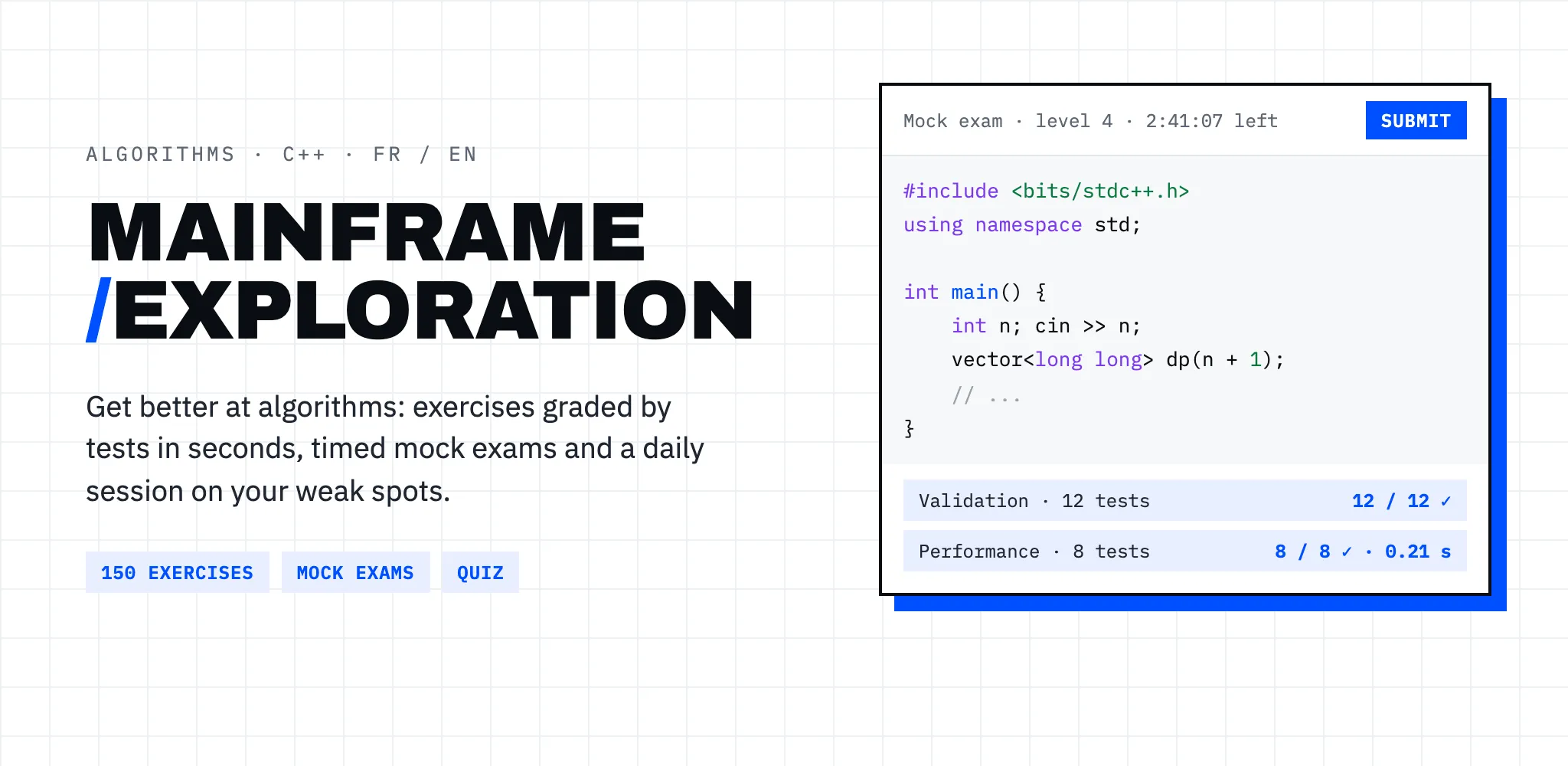
A platform to get better at algorithms in C++: 186 exercises graded by a home-made judge, timed mock exams and a review quiz.
- Role
- Design, content and development
- Stack
- React, TypeScript, Node.js, Supabase, PostgreSQL, C++, Docker
- Status
- Online
- Links
- Website ↗
The project
Mainframe Exploration helps you get better at algorithms, from your first array to flows and segment trees. You solve exercises in C++, sorted by level, and every solution is graded against hidden tests in a few seconds. Each day the site picks exercises from your weakest topics, and timed mock exams let you measure yourself over a set duration.
What it does
- 186 original exercises from level 1 to level 6, rated easy, medium or hard, whose method stays hidden until you solve them
- C++ editor in the browser, with syntax colouring, smart indentation and auto-closed brackets
- Submissions graded in a few seconds, with a verdict per test: validation tests, then performance tests, and a 20-point penalty for each submission before the best one
- Mock exams from 1 to 4 hours: as many exercises around the chosen level as the time allows, a preview before starting, a timer, a report and a history
- Daily session built from your weakest topics, using success, attempts, time taken, hints and how long ago you practised
- A quiz of 1,245 checked questions over 83 topics, in rounds of 10, with spaced review of mistakes
- A sandbox to run C++ on any input, with output, time and memory
- French and English interface, dark or light theme, sign-in by e-mail link or code
- Coming next: an arena of bot duels between friends
Under the hood
- React 19, TypeScript and Vite front end, CodeMirror editor, interface translated without a library
- Supabase: sign-in, a PostgreSQL database with per-user access rules, and SQL functions that keep methods and quiz answers on the server (daily session, exam plan, review)
- Node.js judge: every submission runs in a throwaway Docker container, with no network, a read-only file system and limited memory and processes
- Time limits calibrated on the judging machine, from the reference solution
- Every exercise has a reference solution, a separately written slow solution and a too-slow naive one. The reference is compared with the slow solution on hundreds of random cases, then a second, independent reviewer checks the whole exercise again
- Exams sized from an estimated solving time per exercise, based on its level and difficulty
- Site and judge hosted on a VPS behind an edge proxy, with a strict content security policy